

Coffee With Adaptogens for Focus: 2026 Guide
Table of Contents
- What Adaptogens Actually Do for Focus
- The Benefits of Adaptogens for Energy and Stress Resilience
- Nootropics vs Adaptogens in Coffee: Two Jobs, One Cup
- How to Choose an Adaptogenic Coffee Blend
- What a Disclosed Formula Looks Like in Practice
- Caffeine Sensitivity, Jitters, and Timing Your Cup
- Short-Term Lift vs Long-Term Payoff: What to Expect
- Frequently Asked Questions
Last Updated: September 21, 2026
What Adaptogens Actually Do for Focus
Adaptogens are botanical compounds that help the body manage stress and return to balance, and coffee with adaptogens for focus pairs those compounds with caffeine to smooth out the spike-and-crash cycle. Rhodiola and Lion's Mane are common additions to coffee blends, chosen because they support the nervous system rather than simply stimulating it.
The distinction matters. Caffeine blocks adenosine receptors, which delays the feeling of tiredness. Adaptogens work on a slower timeline. They modulate the stress response, which means the cortisol spike from a strong cup doesn't hit as hard.
At DIALED, we built our formula around this idea: real coffee, full caffeine, plus a disclosed stack of adaptogens and nootropics. No reduction, no proprietary blend hiding the doses.

Most people notice the difference in how the energy feels, not in how much energy they have. That's the point.
The Benefits of Adaptogens for Energy and Stress Resilience
The benefits of adaptogens for energy show up in two places: how long focus lasts and how well you handle pressure during that window.
- Sustained energy without the crash. L-theanine, found naturally in green tea, takes the edge off caffeine's peak.
- Better stress response. Rhodiola is studied for its effect on cortisol regulation during demanding periods.
- Mental clarity under load. Lion's Mane supports cognitive function, which matters more in hour four of deep work than hour one.
- Fewer jitters. The combination of stimulant and calming compound produces a flatter curve than coffee alone.
What most guides miss is that these effects compound. One cup doesn't transform your afternoon. A consistent habit over weeks does.
Nootropics vs Adaptogens in Coffee: Two Jobs, One Cup
Nootropics vs adaptogens in coffee comes down to function: nootropics target cognitive performance directly, while adaptogens target the stress response that undermines it. Alpha-GPC and L-tyrosine are nootropics. Rhodiola is an adaptogen.
They overlap in practice. A stressed brain can't focus, so reducing stress improves focus. A well-fed brain still struggles if cortisol is spiking all day.
A formula that includes both addresses the cognitive side and the physiological side. That's why blends built for deep work tend to stack them rather than pick one.
How to Choose an Adaptogenic Coffee Blend
Choose based on the label, not the marketing. Four things separate a serious blend from a dusted one, and the fourth is the one almost no guide explains.
First, look for individual doses. A proprietary blend lets a company list ingredients without amounts. If you can't see how much Rhodiola is in the scoop, you can't evaluate it. Published research on Rhodiola rosea typically uses standardized extracts in the 200-400 mg range per day.
Second, check the extract ratio and standardization. A 10:1 extract means ten parts raw material became one part extract. But ratio alone isn't enough, look for standardization to a marker compound, like 3% rosavins and 1% salidroside for Rhodiola. Standardization is what makes a dose reproducible batch to batch.
Third, verify third-party testing. Purity and potency claims mean little without an independent lab behind them. Look for a certificate of analysis (COA) available on request, and check whether the lab tests for heavy metals, microbials, and identity, not just potency.
Fourth, and this is the one competitors skip, learn to tell fruiting body from mycelium on grain. This is the single biggest quality variable in mushroom coffee, and the label rarely makes it obvious.
Fruiting Body vs. Mycelium on Grain: The Label Trick
Lion's Mane and other functional mushrooms can be sold as either the fruiting body (the actual mushroom you'd see growing) or as mycelium, the root-like network, grown on a grain substrate like oats or rice.
The problem: mycelium grown on grain absorbs starch from that grain, and the final powder can be 30-60% starch by weight. That starch is filler. It bulks up the gram count on the label without delivering the beta-glucans and hericenones that the research on Lion's Mane actually studies.
How to spot it:
- "Mycelium on grain" or "myceliated grain" on the ingredient line is the tell. So is "mycelial biomass."
- "100% fruiting body" or "fruiting body extract" is what you want for cognitive-support claims.
- Beta-glucan content is the honest potency marker. A fruiting-body extract will typically list a beta-glucan percentage (often 25% or higher); a grain-grown mycelium powder often can't, because the starch dilutes it.
- "Mushroom coffee" with no species-level detail is usually a blend of myceliated grain powders. If the bag won't say fruiting body, assume it isn't.
This matters for focus specifically because the compounds studied for cognitive function, hericenones and erinacines in Lion's Mane, are concentrated in the fruiting body and in the mycelium respectively, but the grain substrate contributes neither.
Read the Label Before the Marketing
Front-of-bag claims are unregulated in most cases. The supplement facts panel is where the real information lives.
If a bag says "mushroom coffee" and lists a blend, you're guessing. If it lists Lion's Mane at a specific milligram amount, names the extract ratio, states "fruiting body," and gives a beta-glucan percentage, you're not.
Ground, Instant, or Scoop: Which Format Fits Your Routine
| Format | Best For | Trade-off |
|---|---|---|
| Ground | Traditional brewing ritual | Slower prep, less portable |
| Instant | Travel and office desks | Often lower coffee quality, harder to verify extract quality |
| Scoop | Precise dosing, full-strength coffee | Requires a mug and hot water |
The scoop format wins for anyone tracking intake. You get the exact dose every time, which is the whole point of a disclosed formula, and it's the only format where you can easily adjust the ratio if you're managing caffeine sensitivity.
What a Disclosed Formula Looks Like in Practice
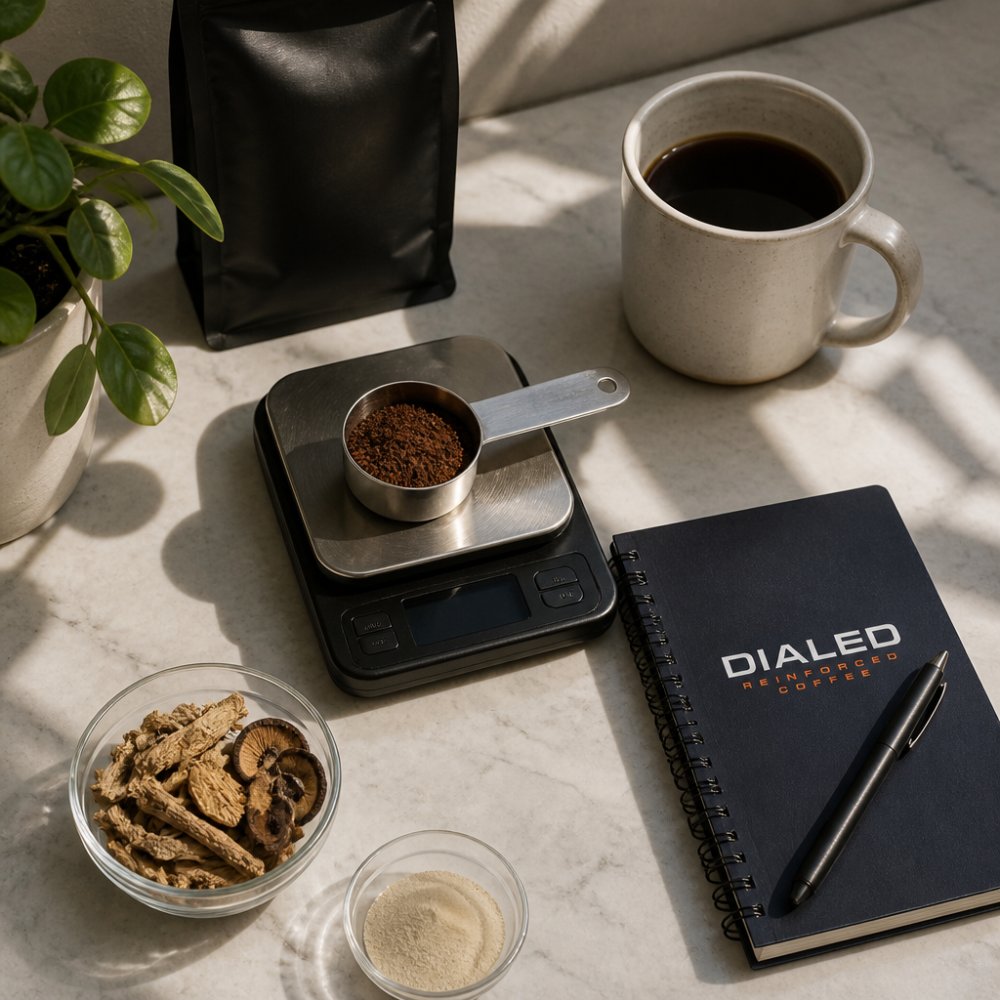
A disclosed formula looks like a supplement facts panel with every active ingredient listed at its exact milligram dose, no blend totals, no "proprietary matrix" language. You can read it, compare it to published research, and decide whether the amounts are meaningful.
DIALED lists Alpha-GPC, L-Tyrosine, Rhodiola, L-Theanine, and Lion's Mane individually.
Caffeine Sensitivity, Jitters, and Timing Your Cup
If caffeine usually makes you shaky, the problem is often the rate of absorption, not the total amount. L-theanine is the most direct fix. It's the reason green tea feels calmer than coffee despite containing caffeine. L-theanine crosses the blood-brain barrier and increases alpha-wave activity, which is associated with a relaxed-but-alert state, it doesn't block caffeine, it changes how the stimulation feels.
For sensitive drinkers, work the variables in this order:
- Ratio first. Add or increase L-theanine before you cut caffeine. It's the cheapest fix and the one with the clearest mechanism.
- Timing second. Keep your cup before noon if sleep is a concern. Caffeine's adenosine-blocking effect is dose- and clock-dependent.
- Food third. Drink your cup after eating, not on an empty stomach. Food slows absorption and flattens the peak.
- Dose last. Start with half a scoop and titrate up over a week. Full-caffeine formulas aren't a problem if the ratio and timing are right.
Short-Term Lift vs Long-Term Payoff: What to Expect
The first cup feels like a smoother version of coffee. That's the short-term effect, and it's real but modest.
Frequently Asked Questions
What does adaptogenic coffee actually do?
It combines regular coffee with adaptogenic herbs and mushrooms that support how your body handles stress. The caffeine still delivers alertness, while ingredients like Rhodiola, L-Theanine, and Lion's Mane are included to support stress resilience and mental clarity. The goal is a smoother focus curve rather than a sharp spike followed by an afternoon drop. Effects vary by person, so pay attention to how you feel across a full workday before judging it.
How do I choose an adaptogenic coffee blend without wasting money?
Start with the label. Look for individually dosed ingredients rather than a proprietary blend, since a blend hides how much of each item you actually get. Check whether the coffee is full-strength or decaffeinated, confirm third-party testing, and match the format to your routine. Scoop-style products like DIALED Reinforced Coffee ($59 for a 30-day pouch) suit people who want a fixed daily dose instead of guessing at a mushroom powder scoop.
Are there side effects to drinking coffee with adaptogens?
Most people tolerate these blends well, but caffeine is still caffeine. If you are sensitive to stimulants, watch your total daily intake and avoid stacking a cup on top of your usual three. Some adaptogens, including Rhodiola, can interact with medications, so check with your doctor if you take prescriptions. Start with one serving, note how you feel, and adjust timing rather than adding more.
Can adaptogenic coffee replace my daily energy drink?
It can, and for many people it is a cleaner swap. Energy drinks often carry high sugar and a large caffeine load with little else. A coffee with adaptogens gives you real coffee plus ingredients aimed at sustained energy and nervous system support, which is why the crash tends to be milder. Track your caffeine total either way, since replacing a 200 mg drink with a strong coffee does not automatically lower your intake.
Caffeine alone gets you through the morning. It rarely gets you through a six-hour deep work block without a cost.
DIALED was built for that gap: full-strength coffee with a disclosed stack of nootropics and adaptogens, every ingredient individually dosed, third-party tested, and made in the USA. No proprietary blends, no fairy dust.
Get DIALED and see what sustained focus actually feels like.