

Why Proprietary Blends Are Bad: The Hidden Dosage Problem
Table of Contents
- What Is a Proprietary Blend and Why It Hides What You Need to Know
- The Real Problem: Dosage Transparency and Pixie Dusting
- The Dangers of Underdosed Supplements: When Labels Lie by Omission
- FDA Supplement Labeling Requirements: What the Rules Actually Allow
-
How to Read Supplement Labels: A Step-by-Step Guide
- Step 1: Find the Supplement Facts Panel
- Step 2: Scan for the Blend Trigger Words
- Step 3: Count the Ingredients Inside Each Blend
- Step 4: Read the Descending Order
- Step 5: Compare Named Ingredients Against Research Doses
- Step 6: Check the Serving Size Against the Dose
- Step 7: Look for Third-Party Testing Marks
- Step 8: Read the "Other Ingredients" Line
- The Red-Flag Decoder
- Legitimate Synergy vs. Cost-Cutting Blend
- Chemical Interaction Risks and Hidden Ingredient Dangers
- What Full Transparency Looks Like in Practice
- Frequently Asked Questions
Last Updated: September 28, 2026
What Is a Proprietary Blend and Why It Hides What You Need to Know
Proprietary blends are groups of ingredients listed under a single combined weight instead of individual amounts. The label might say "Focus Matrix 1,200 mg," but it won't tell you how much of each ingredient sits inside that total. That's the entire point of the format, and it's why proprietary blends are bad for anyone trying to make an informed decision.
At DIALED, we built our formula around the opposite principle: every ingredient individually dosed and disclosed on the label. To understand why that matters, you first need to see how the blend format works and what it conceals.
The math is simple and brutal.
The Real Problem: Dosage Transparency and Pixie Dusting
Dosage transparency is the practice of disclosing the exact milligram amount of every active ingredient. When a company hides behind a proprietary blend, it can list an ingredient for label appeal while including so little of it that it produces no measurable effect.
How Underdosing Becomes Invisible
Underdosing hides inside the blend total. Consider a formula that lists lion's mane, rhodiola, and alpha-GPC together as a 500 mg blend. Published research on these compounds typically uses doses in the hundreds of milligrams individually. If all three share 500 mg, at least two of them are almost certainly below any threshold that matters.
The Dangers of Underdosed Supplements: When Labels Lie by Omission
The dangers of underdosed supplements rarely show up as harm. They show up as wasted money and misplaced trust. You buy a product for a specific ingredient, take it for months, feel nothing, and conclude the ingredient doesn't work, when you never took a real dose of it. A product that lists an ingredient but underdoses it isn't dangerous in the acute sense.
- Wasted spending: You pay for ingredients you never receive at effective levels
- False conclusions: You rule out compounds that might have worked at proper doses
- Compounded risk: Stacking multiple underdosed products makes it impossible to track what you're actually consuming
- Eroded trust: One bad experience with a pixie-dusted product colors your view of the entire category
FDA Supplement Labeling Requirements: What the Rules Actually Allow
FDA supplement labeling requirements do mandate that ingredients be listed, but the rules permit a manufacturer to group ingredients into a single blend entry with one combined weight. That allowance is the legal foundation for everything above, and it lives in Title 21 of the Code of Federal Regulations, section 101.36(c)(1)(ii).
The Loophole That Lets Blends Hide
The blend allowance exists so companies can protect what they consider trade secrets, a legitimate concern in theory. In practice, the loophole lets a company list expensive, research-backed ingredients at token amounts while the blend total does the marketing work. The consumer sees a long ingredient list and a big milligram number and assumes both mean something.
What the FDA Does and Doesn't Police
The agency's enforcement priorities are narrower than most consumers assume:
Reinforced Coffee + Reinforcement →
- It does require that the Supplement Facts panel be accurate, if a blend says 1,200 mg, the ingredients inside must total 1,200 mg.
- It does require that ingredients be listed in descending order of predominance within a blend.
- It does not require that any ingredient be present at a clinically studied dose.
- It does not require pre-market proof that the formula works.
- It does not require disclosure of individual ingredient amounts inside a blend.
How to Read Supplement Labels: A Step-by-Step Guide
Learning how to read supplement labels comes down to finding the numbers that matter and treating everything else as marketing. Here's a decoding framework, a way to read the panel the way a formulator does, so you can tell a legitimate synergistic formula from a cost-cutting blend in under a minute.
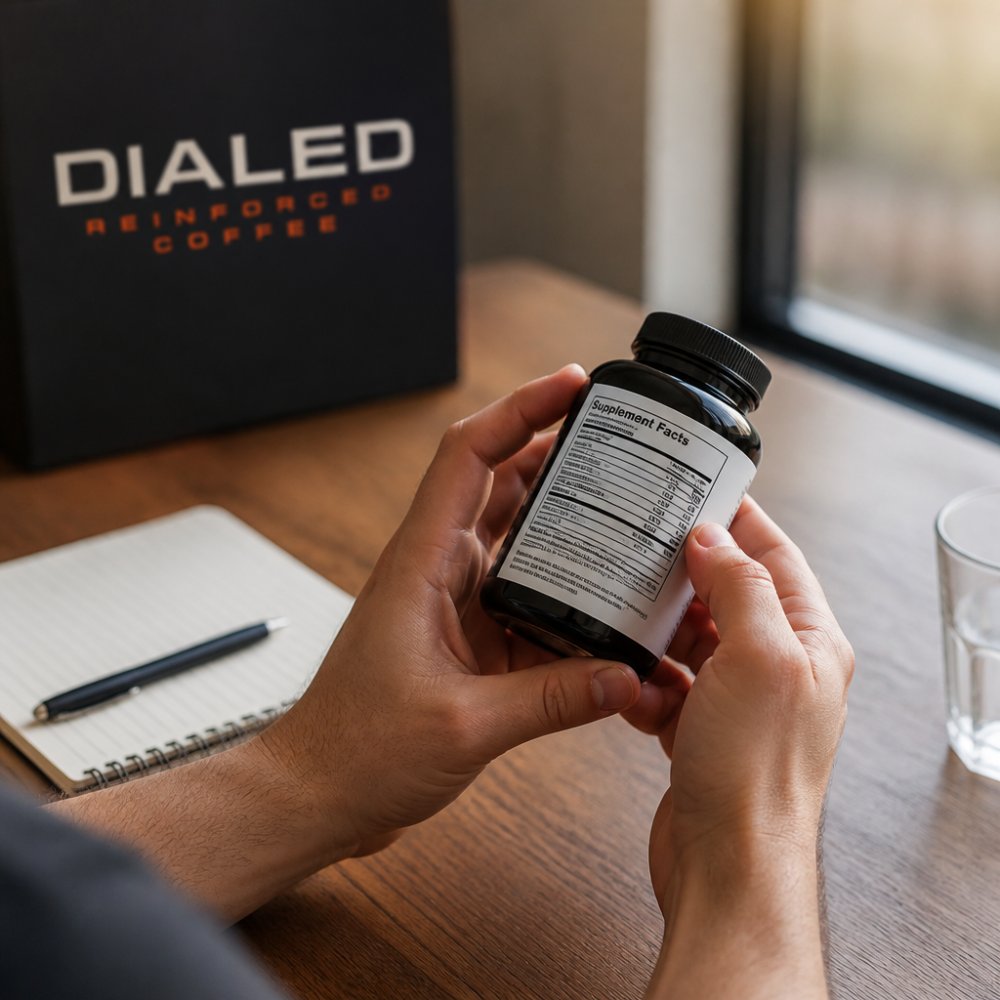
Step 1: Find the Supplement Facts Panel
This is the only section with regulated content. Everything on the front of the package is persuasion. The panel is where a manufacturer is legally bound to what's printed.
Step 2: Scan for the Blend Trigger Words
Any entry ending in "blend," "matrix," "complex," "proprietary," "system," or "formula" is a group total, not a dose. Circle every one. A product with three separate blends is hiding three separate dose problems.
Step 3: Count the Ingredients Inside Each Blend
A blend with two ingredients and a 1,000 mg total is very different from one with twelve ingredients and the same total. The more ingredients pooled under one number, the smaller each individual dose is likely to be. Twelve ingredients sharing 1,000 mg averages roughly 83 mg each, well below the studied dose for most botanicals and amino acids.
Step 4: Read the Descending Order
The regulation requires ingredients inside a blend to be listed in descending order by weight, so the first ingredient is the largest, but "largest" is relative. If a blend lists lion's mane first and alpha-GPC last, lion's mane is the biggest slice. It does not tell you whether that slice is 400 mg or 40 mg.
Step 5: Compare Named Ingredients Against Research Doses
A named ingredient at 50 mg when studies use 300 mg is pixie dusting with a familiar label. The descending order becomes a tell: if the last-listed ingredient is the one the front of the package advertises most heavily, the marketing and the formula point in opposite directions.
Step 6: Check the Serving Size Against the Dose
A label can list a real dose per serving while the package contains a fraction of a serving per scoop. Read the servings-per-container line and do the math on what a full day actually delivers.
Step 7: Look for Third-Party Testing Marks
Certification programs verify that what's on the label matches what's in the bottle. A blend with no testing mark is a blend with no external check on whether the total weight is even accurate.
Step 8: Read the "Other Ingredients" Line
This is where fillers, sweeteners, flow agents, and undeclared additives live. It sits below the Supplement Facts panel and is easy to ignore. Don't.
Reinforced Coffee + Reinforcement →
The Red-Flag Decoder
Run any label through these five questions. Two or more red flags means the blend is doing marketing work, not formulation work.
- Does the word "blend" appear anywhere in the Supplement Facts panel? One is a caution. Three is a pattern.
- Does a single blend pool more than five ingredients under one total? The math almost guarantees at least one ingredient is underdosed.
- Are the trendy, front-of-package ingredients listed last inside the blend? That's the signature of pixie dusting.
- Is there no third-party testing mark? No external verification means no external check on the blend total itself.
- Do the front-of-package claims outpace anything the facts panel supports? If the marketing promises what the panel can't prove, the panel is the truth and the front is the pitch.
Legitimate Synergy vs. Cost-Cutting Blend
Not every blend is deceptive. A small number of formulators use blends to protect a genuinely novel ratio where the ingredients are studied together as a combination. The tell is whether the company can point to research on the combination itself, not just on the individual ingredients. If a brand cites studies on each ingredient separately but hides the ratio, that's a cost-cutting blend wearing a synergy costume.
Chemical Interaction Risks and Hidden Ingredient Dangers
Blends don't just obscure doses. They obscure combinations, and that's a separate problem with real consequences. When you can't see individual amounts, you can't evaluate how ingredients interact. Some compounds compete for the same absorption pathways. Others amplify each other's effects, which is desirable at controlled ratios and unpredictable at unknown ones.
What Full Transparency Looks Like in Practice
Full transparency means every active ingredient carries its own milligram amount on the label, no group totals, no blend entries, no ambiguity. That standard is achievable, and it's the one we hold ourselves to at DIALED. Our Reinforced Coffee lists Alpha-GPC, L-Tyrosine, Rhodiola, L-Theanine, and Lion's Mane as separate line items with individual doses, grounded in published research rather than pooled into a fairy-dusted total.

Frequently Asked Questions
Why do companies use proprietary blends instead of full disclosure?
Companies use proprietary blends to protect their formula from competitors, but the real effect is that they can use tiny amounts of expensive ingredients while listing them prominently. A blend might contain 500 mg total, but only 10 mg of the ingredient you actually wanted. Full disclosure would reveal that the formula is mostly filler. Brands that dose every ingredient at research-backed levels, like DIALED, disclose every milligram because they have nothing to hide.
How do I read a supplement label to identify hidden ingredients?
Look for the words 'proprietary blend,' 'matrix,' or 'complex' on the Supplement Facts panel. These terms let manufacturers list ingredients without individual milligram amounts. If you see a total weight followed by a list of ingredients in parentheses, the dose of each ingredient is unknown. A transparent label lists every ingredient with its exact milligram amount. If you cannot find the dose for an ingredient you care about, assume it is underdosed.
What are the dangers of underdosed supplements?
Underdosed supplements waste your money and may not deliver the benefits you expect. More seriously, if a blend contains a stimulant or active compound at an unknown dose, you cannot predict how it will interact with medications or other supplements. The dangers of underdosed supplements include unexpected side effects, lack of efficacy, and difficulty identifying what caused a reaction. Without knowing the dose, you cannot make informed decisions about your health.
Is a proprietary blend ever a sign of quality?
No. A proprietary blend is a sign that the manufacturer is choosing marketing flexibility over label transparency. Quality brands disclose every ingredient and dose because they formulate at levels supported by research and want you to verify that. When a brand hides doses, it usually means the amounts are too small to be effective or too large to be safe. Full disclosure is the baseline for trust.