

Are Adaptogens Safe With Morning Coffee? A Practical Guide
Last Updated: November 12, 2026
Quick Summary
Pairing adaptogens with coffee is safe for many people, but it depends on the specific ingredient, dose, and your caffeine sensitivity. Some adaptogens have mild stimulating effects of their own, so stacking them with strong coffee can leave sensitive people overstimulated, anxious, or unable to sleep. Treat your adaptogen serving as part of your total stimulant load.
- Ashwagandha contains no caffeine; in ashwagandha coffee the caffeine comes from the coffee.
- Common ashwagandha and coffee side effects include digestive upset, drowsiness, and a groggy-but-wired feeling.
- Take stimulating adaptogens like rhodiola in the morning and calming ones like ashwagandha not at night.
- If you are caffeine-sensitive, separate the coffee and adaptogen by 30 to 60 minutes.
- Check the Supplement Facts panel for milligrams per active, extract type, and caffeine per serving.
Table of Contents
- How Adaptogens and Coffee Interact in Your Morning Cup
- Ashwagandha and Coffee Side Effects: What to Watch For
- Does Ashwagandha Have Caffeine? Separating Fact From Label Confusion
- How Much Ashwagandha Per Day Is Considered Safe
- The Best Time of Day to Take Adaptogens With Caffeine
- Who Should Be Cautious: Medications, Conditions, and Caffeine Sensitivity
- How to Evaluate Adaptogen Coffee Products Before You Buy
- Start With a Cautious Introduction Plan
- Frequently Asked Questions
How Adaptogens and Coffee Interact in Your Morning Cup
Adaptogens are plant and fungi extracts that are commonly used to support the body's response to stress, and whether pairing them with coffee is appropriate depends on the specific ingredients, doses, and individual health.

Here is the short version before the details. The risk generally goes up when high caffeine intake, high adaptogen doses, and a sensitive system are combined.
The Caffeine-Adaptogen Interaction
Caffeine blocks adenosine, the chemical that makes you feel tired. Adaptogens such as rhodiola and ashwagandha are generally described as acting on the stress response.
But the interaction is not always gentle. Some adaptogens have mild stimulating effects of their own.
One practical rule: treat your adaptogen serving as part of your total stimulant load, not as a separate thing.
What the Research Actually Shows
The research is generally described as thin and uneven. Many adaptogens have small studies behind them, often short in duration and mixed in quality, and few look at adaptogens combined with caffeine specifically.
That matters for how you read product claims. A label that says "clinically studied" usually means one ingredient was studied, not that the finished blend was. Look for disclosed doses you can check against published research, and treat bold claims with calm skepticism.
Ashwagandha and Coffee Side Effects: What to Watch For
The most common ashwagandha and coffee side effects are digestive upset, drowsiness, and an odd groggy-but-wired feeling when a calming herb meets a strong stimulant. Most people notice nothing at all.
Watch for these, and stop if they show up:
- Stomach discomfort or loose stools, usually from larger doses
- Drowsiness within an hour of your cup
- Irritability or restlessness instead of calm focus
A common mistake is taking a large ashwagandha dose with a second or third coffee and blaming the coffee for the jitters. Split the two apart and see what changes.
Does Ashwagandha Have Caffeine? Separating Fact From Label Confusion
No. Ashwagandha contains no caffeine. It is a root extract, and caffeine is not part of its makeup.
Confusion comes from the product, not the herb. Blends that hide doses behind a vague total make this worse, which is why why proprietary blends are bad is worth reading before you buy anything.
Check the label for three things: total caffeine per serving, the ashwagandha dose in milligrams, and whether every other ingredient is listed individually. If any of those are missing, you cannot judge what you are drinking.
How Much Ashwagandha Per Day Is Considered Safe
Individual response varies, and any dose should be discussed with a healthcare professional.
Discuss starting amounts with a healthcare professional before adjusting your routine.
If you are already taking a separate ashwagandha capsule, do not add a second serving through your coffee without doing the math first.
The Best Time of Day to Take Adaptogens With Caffeine
Timing depends on how each adaptogen affects you, and questions about when to take them are best discussed with a healthcare professional.
The best time of day to take adaptogens depends on what they do to you:
- Rhodiola and similar stimulating adaptogens: morning, alongside coffee
- Ashwagandha and calming herbs: morning or early afternoon, not at night
- Anything that makes you drowsy: after lunch, never before a drive
Keep caffeine before mid-afternoon if sleep is fragile. A late cup plus an adaptogen is a poor combination for anyone who already struggles to wind down.
Who Should Be Cautious: Medications, Conditions, and Caffeine Sensitivity
Safety is not a single yes-or-no answer for adaptogens. It depends on the specific ingredient, the dose, your medications, your health conditions, and your caffeine sensitivity. Treating all adaptogens as interchangeable is the most common mistake readers make, and it is the one most likely to cause problems.
Here is how the risk picture changes by ingredient and circumstance.
Ingredient-Specific Interactions
Ashwagandha is the most studied adaptogen in coffee blends, and it carries the most interaction flags. There are case reports of liver injury with ashwagandha supplements, so anyone with a history of liver disease should be especially cautious (Ashwagandha-induced liver injury, A case series from India and literature review).
Rhodiola rosea has mild stimulating properties and may interact with antidepressants, particularly MAOIs and SSRIs, and with stimulants. If you are sensitive to caffeine, rhodiola can amplify that edge rather than smooth it.
This is not a complete list, and it is not a substitute for professional advice. The point is that "adaptogen" is a category, not an ingredient. A blend with five extracts carries five separate interaction profiles, and the finished product has not been tested for safety in combination.
Health Conditions That Raise the Risk
Certain conditions warrant a conversation with a healthcare professional before you add any adaptogen to your coffee:
- Pregnancy and breastfeeding: Evidence is limited, and some adaptogens have traditional warnings against use during pregnancy. Avoid unless a clinician specifically approves.
- Children and adolescents: Adaptogens should only be used with guidance from a healthcare professional for this group.
- Thyroid conditions: Ashwagandha and some other adaptogens can influence thyroid function. If you have hypothyroidism, hyperthyroidism, or Hashimoto's, get advice first.
Caffeine Sensitivity Is Its Own Variable
If one cup of coffee already makes you shaky, irritable, or sleepless, adding adaptogens will not reliably fix that. Some adaptogens may take the edge off, but they do not cancel caffeine.
A practical approach: if you are caffeine-sensitive, start with a smaller coffee serving and a low adaptogen dose, and separate them by 30 to 60 minutes so you can tell which one is doing what. Our guide on how to avoid caffeine jitters covers dose and timing steps that work alongside any blend.
Watch out: if you take thyroid medication, sedatives, antidepressants, blood thinners, diabetes medication, or immunosuppressants, get advice before you start, not after. Bring the actual product label to that conversation so the clinician can see every ingredient and dose.
How to Evaluate Adaptogen Coffee Products Before You Buy
Judging an adaptogen coffee product takes more than reading the front of the bag. The label is where the real information lives, and most products are designed to make that information hard to compare. Here is a method for cutting through it.
Start With the Supplement Facts Panel
The Supplement Facts panel is the only part of the label held to a standard format. Read it in this order:
- Serving size. Check whether the serving is one scoop, one cup, or two tablespoons. A product that lists a small adaptogen dose per tiny serving may require multiple servings to reach a meaningful amount, which also multiplies your caffeine.
- Extract type and standardization. Look for the plant part (root, leaf, aerial parts) and whether the extract is standardized to a marker compound, such as withanolides for ashwagandha or rosavins and salidroside for rhodiola. A standardized extract states a percentage, for example "standardized to 5% withanolides." A plain root powder is not the same thing and is usually cheaper and less concentrated.
- Milligrams per active ingredient. Every active should have its own number. If the panel lists a "proprietary blend" with a total milligram amount and no individual doses, you cannot verify whether the product contains a meaningful amount of anything.
- Caffeine per serving. This should be stated clearly, ideally in milligrams. Coffee naturally varies, so a disclosed number tells you whether the product is a standard cup or a high-stimulant drink.
- Other ingredients. Look for added sugars, creamers, flavorings, and sweeteners. These affect calories and taste but also can mask a low active dose.
Check the Extract Type Against the Research
Most published research on adaptogens uses specific extracts at specific doses, not whole roots or arbitrary blends. If a product cites a study, check whether the study used the same extract form and amount.
This is where blend transparency matters. A product that discloses each ingredient and dose lets you compare it to the research. A product that hides behind a blend total does not.
Look for Third-Party Testing by Name
Third-party testing is a quality signal, but only if you can verify it. Look for the name of the testing lab or certification program on the label or the brand's website, not just a generic "third-party tested" badge. Common programs include NSF Certified for Sport and USP Verified, though not every adaptogen product will carry either. If a brand mentions testing but will not name the lab or provide a certificate of analysis, treat that as a marketing claim rather than a quality guarantee.
Evaluate the Caffeine Math
Add up the caffeine you already drink and compare it to the product. A 12-ounce coffeehouse coffee can range widely, and a cold brew or espresso drink may be higher than you expect. If the adaptogen coffee adds caffeine on top of your usual cups, you may be stacking more stimulant than you intended. The product should make this easy by stating caffeine per serving.
A Quick Label Scorecard
Use this to compare products side by side:
- Every active ingredient listed with a milligram amount
- No proprietary blend hiding doses
- Extract type and standardization stated
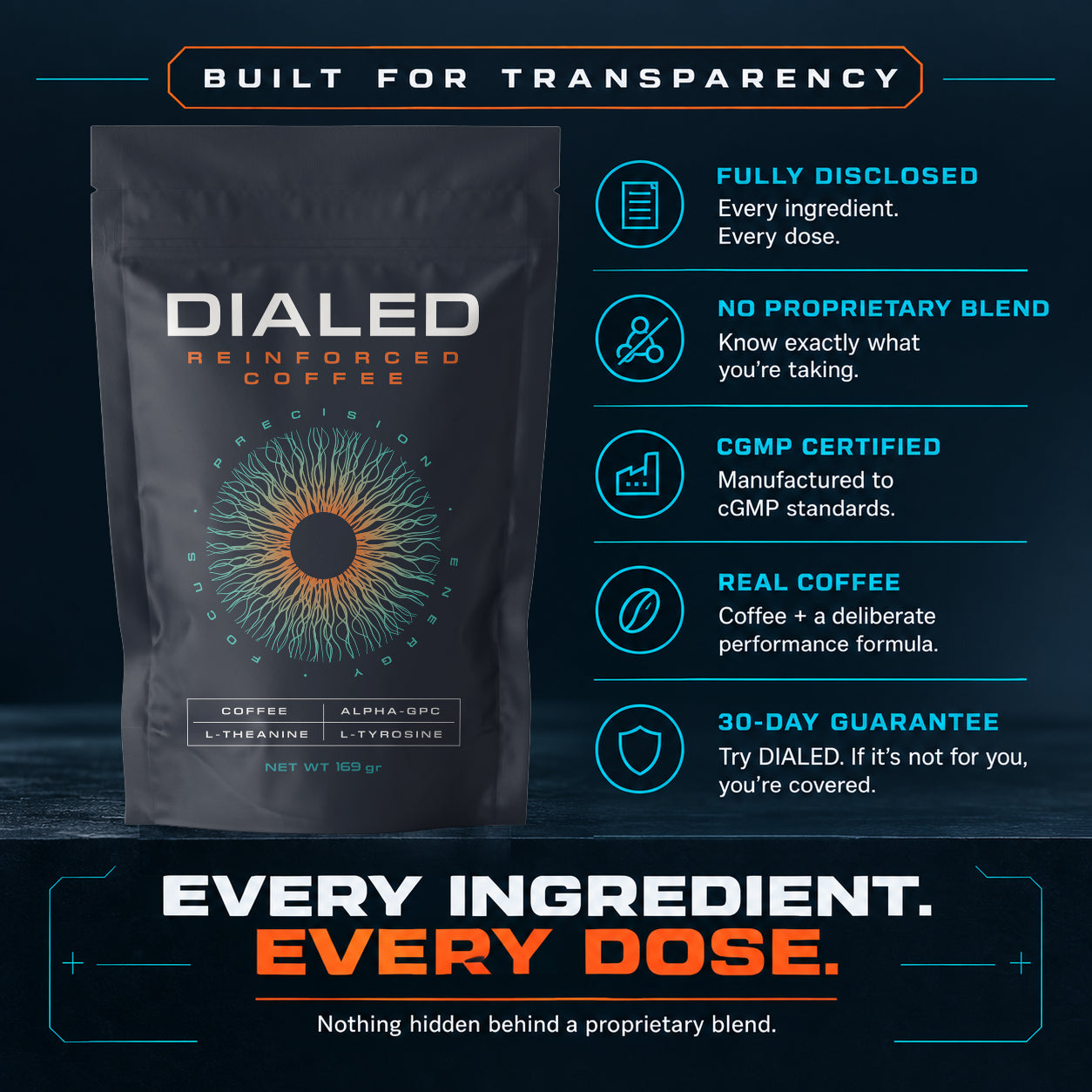
This is where most products fail. You can see the difference on a label like DIALED Reinforced Coffee, which doses and discloses each active ingredient, or check what is in your scoop to compare against the criteria above.
A product can pass every label check and still not suit you. Label quality tells you what is in the bag, not whether the combination is right for your medications, conditions, or caffeine sensitivity.
Read the Supplement Facts panel in this order to compare products on facts rather than front-of-bag claims.
| Label item | What to check | Why it matters |
|---|---|---|
| Serving size | One scoop, one cup, or two tablespoons | Small servings may multiply caffeine |
| Extract type | Plant part and standardization percentage | Plain root powder is cheaper and less concentrated |
| Milligrams per active | Each active has its own number | Blend totals hide individual doses |
| Caffeine per serving | Stated clearly, ideally in milligrams | Shows standard cup versus high-stimulant drink |
| Other ingredients | Added sugars, creamers, flavorings, sweeteners | Can mask a low active dose |
| Third-party testing | Named lab or certificate of analysis | Generic badges are marketing claims |
Start With a Cautious Introduction Plan
Easing in gradually can make it easier to notice how your body responds. Your body gives you better signals when you change one variable at a time.
- Days 1-3: Half a serving with your normal coffee. Note energy, mood, and sleep.
- Days 4-7: Full serving, same time each morning. Keep total caffeine steady.
- Week 2: Adjust timing, not dose. Move the serving earlier if sleep suffers.
- Week 3 onward: Hold the routine for a week before adding anything else.
If you feel anxious, wired, or flat, reassess your routine and speak with a healthcare professional.
The real challenge is not whether adaptogens and coffee can coexist. It is finding a product that tells you exactly what you are drinking.
Frequently Asked Questions
What happens if I take ashwagandha with coffee?
Ashwagandha contains no caffeine, so combining it with coffee does not raise your caffeine intake. The concern is tolerance and timing. Some people report drowsiness or digestive upset from ashwagandha, which can feel odd alongside a stimulant. Speak with a healthcare professional about starting amounts and watch for changes in sleep or stomach comfort.
Can adaptogens make caffeine jitters worse?
They can if you stack stimulant-like herbs on top of a high caffeine load. Some adaptogens may be activating for some people, so combining them with several cups of coffee may increase restlessness. Track your total daily caffeine and discuss appropriate limits with a healthcare professional.
Do adaptogens have caffeine?
Most adaptogenic herbs and mushrooms, including ashwagandha, rhodiola, lion's mane, and reishi, contain no caffeine. The caffeine in an adaptogen coffee product comes from the coffee itself or from any other caffeine-containing ingredients listed on the label. Check the supplement facts panel for total caffeine per serving rather than assuming the adaptogens are the source.
What is the best time of day to take adaptogens?
It depends on the herb. Timing depends on the specific adaptogen and how it affects you. If you are sensitive to sleep disruption, discuss timing with a healthcare professional.
