

All in One Nootropic Coffee Review: 2026 Buyer's Guide
Table of Contents
- All in One Nootropic Coffee Review: What Actually Matters in 2026
- How to Compare All-in-One Nootropic Coffees Side by Side
- Nootropic Coffee Ingredients: What to Look For and What to Ignore
- Mushroom Coffee vs Regular Coffee: Which Base Works Better
- Nootropic Coffee Side Effects and Caffeine Safety
- What Separates the Best Nootropic Coffee From the Rest
- Cost Per Serving, Subscriptions, and Third-Party Testing
- Conclusion: Choosing Your All-in-One Coffee
- Frequently Asked Questions
Last Updated: October 9, 2026
All in One Nootropic Coffee Review: What Actually Matters in 2026
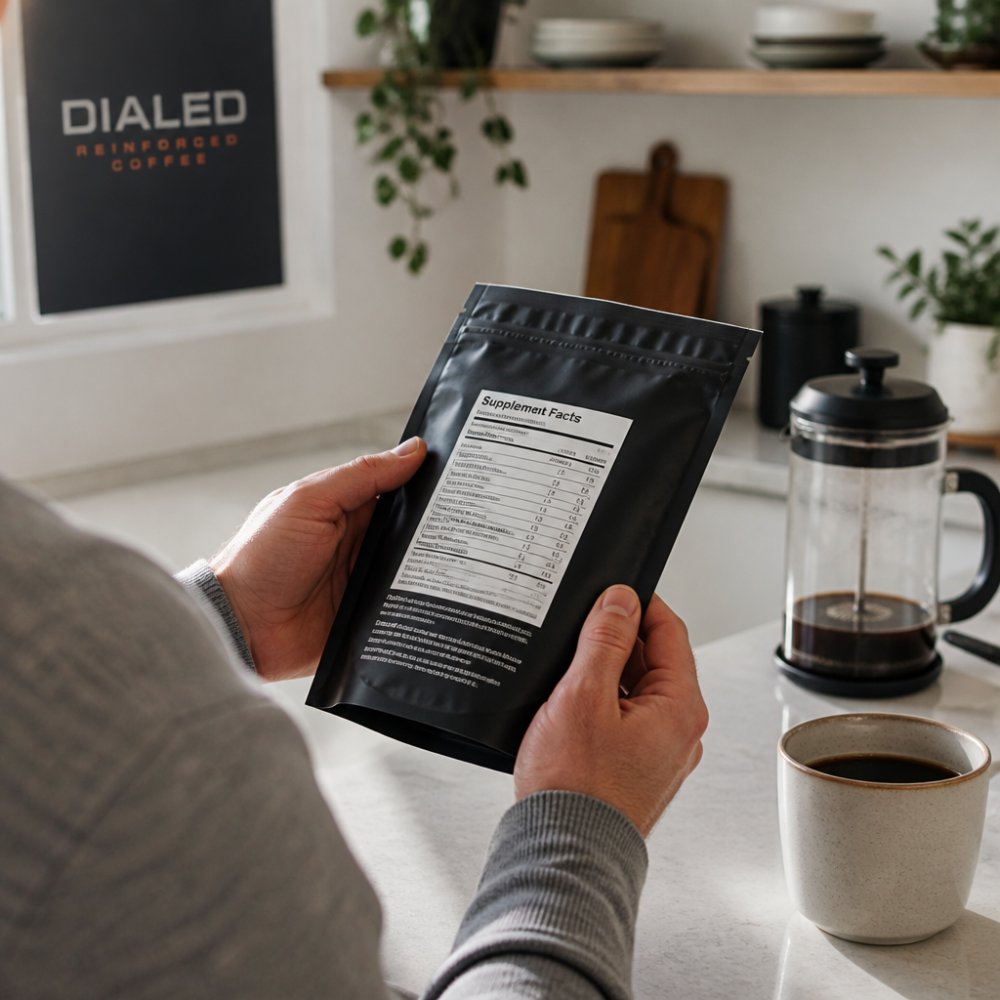
Most "all in one nootropic coffee" products fail the same test: they hide their doses behind a proprietary blend label, so you never learn whether you're getting a clinical dose of anything. At DIALED, we built our reinforced coffee around the opposite rule, with every active ingredient dosed and printed on the label.

Nootropic coffee is a coffee product with added cognitive-support ingredients, typically adaptogens and nootropic compounds, designed to smooth the caffeine curve rather than simply add more stimulant.
A product can call itself nootropic coffee while containing almost no coffee and almost no meaningful nootropic dose. Here's how to separate a real formula from a flavored powder with a clever name.
Nootropic Coffee vs Mushroom Coffee: Clearing Up the Confusion
These two categories get merged constantly, usually as a marketing decision rather than a formulation one.
Mushroom coffee replaces or cuts the coffee with mushroom powders, most often lion's mane or chaga.
Nootropic coffee keeps real coffee as the base and adds cognitive ingredients on top.
The practical question: do you want less caffeine or better-supported caffeine? Answer that first, and half the category eliminates itself.
How to Compare All-in-One Nootropic Coffees Side by Side
Comparing these products takes about ten minutes per label if you know what to look at. Most buyers skip this step and default to packaging.
Start with the supplement facts panel, not the front of the bag. Then work through four checks in order:
- Total caffeine per serving, stated in milligrams
- Individual doses for every active ingredient, not a combined blend total
- Ingredient forms, since some forms absorb far better than others
If a label lists a "cognitive blend" with one total milligram figure and no breakdown, you cannot evaluate it. That's not a transparency problem you can work around. It's a reason to move on.
The Evaluation Criteria That Separate Real Formulas From Marketing
Use this scoring approach when you're holding two labels side by side:
| Criterion | What Good Looks Like | Red Flag |
|---|---|---|
| Dose disclosure | Every ingredient listed separately in mg | One "blend" total |
| Caffeine | Stated clearly per serving | Vague "coffee blend" |
| Ingredient forms | Named, absorbable forms | Unnamed extracts |
| Testing | Third-party tested, stated | No testing claim |
| Cost | Servings per container stated | Price per bag only |
Score each product against those five rows. Anything with two or more red flags isn't worth a trial run.
Nootropic Coffee Ingredients: What to Look For and What to Ignore
The ingredients that carry real weight here are a short list: L-theanine, Alpha-GPC, L-tyrosine, rhodiola, and lion's mane.
L-theanine is the one most people notice first.
Alpha-GPC and L-tyrosine support focus and stress resilience respectively. Rhodiola is an adaptogen used for pressure situations.
Ignore anything with a proprietary blend, unstated extract ratios, or a "focus matrix" that hides individual amounts.
Dose Transparency and Evidence Quality
Dose transparency means every active ingredient appears on the label with its own milligram amount, the single most useful signal in this category.
A product that discloses doses lets you check whether each ingredient sits anywhere near the levels used in published research. A product that doesn't leaves you guessing, and guessing is what you're paying to avoid.
Mushroom Coffee vs Regular Coffee: Which Base Works Better
Regular coffee wins on caffeine delivery, which is usually the point of drinking coffee. Mushroom coffee wins on lower stimulant load and a gentler curve.
For deep work, coding sessions, or long training blocks, the caffeine base is the more useful starting point, provided it's paired with something that smooths the spike.
For people who genuinely want to cut caffeine, mushroom coffee is the right category. Just don't expect it to feel like coffee.
Nootropic Coffee Side Effects and Caffeine Safety
Most of what people call "nootropic coffee side effects" is really caffeine side effects.
The reference point most clinicians use is the FDA's guidance that healthy adults generally consume no more than 400 mg of caffeine per day, roughly four 8-ounce cups of brewed coffee.
Here's where the all-in-one category gets tricky: if your nootropic coffee delivers 100 mg per serving and you drink two, you've used half your daily budget before lunch.
Who Should Be More Careful
- Stimulant-sensitive people. Some people clear caffeine more slowly due to genetics and liver enzyme activity. If one cup keeps you up at night, your personal ceiling is lower than 400 mg.
- People with anxiety disorders. Caffeine can amplify anxiety symptoms, and the effect scales with dose and speed of onset. This is the single most common complaint in the category.
- People on medications. Caffeine interacts with certain stimulants, some antidepressants, and some asthma and cold medications. Check with a pharmacist or physician.
- Pregnant or nursing people. Most guidance recommends limiting caffeine to about 200 mg per day during pregnancy. Confirm with your provider.
Why L-Theanine Changes the Picture
L-theanine is why a well-built nootropic coffee can feel smoother than the same caffeine alone. It's an amino acid found naturally in tea and the most-studied pairing partner for caffeine in the cognitive-supplement space: caffeine blocks adenosine receptors to promote alertness, while L-theanine appears to modulate the excitatory response, softening the onset and reducing perceived jitteriness.
That doesn't make caffeine safe for everyone. It makes the same caffeine load more tolerable for many people. The dose still matters.
How to Stack Caffeine Safely
- Read the caffeine number on the label first. If it isn't stated in milligrams per serving, treat that as a red flag.
- Count your total daily intake across everything you consume, not just the nootropic coffee.
- Start with one serving for the first week and note how you sleep and how you feel mid-afternoon.
- Avoid stacking a nootropic coffee with energy drinks or pre-workout on the same day.
- Cut off caffeine in the early afternoon if you're sensitive to sleep disruption, caffeine has a half-life of roughly five hours in most adults, longer in some.
A common pattern: people who felt jittery on regular coffee find a full-strength nootropic coffee with L-theanine easier to tolerate at the same caffeine dose. That's subjective, not a guarantee, and it doesn't change the daily ceiling.
What Separates the Best Nootropic Coffee From the Rest
The best nootropic coffee discloses every dose, keeps real coffee as the base, and names the ingredient forms. That's the whole test, and very few products pass it.
DIALED Reinforced Coffee is built to that standard.
What most reviews miss is that the coffee itself does most of the work.
You can see the full formula and pricing on the DIALED Reinforced Coffee Pouch.
Cost Per Serving, Subscriptions, and Third-Party Testing
Cost per serving is the only price comparison that means anything here. A $40 bag with 15 servings costs more per cup than a $60 bag with 30. Divide the container price by the actual servings listed, and compare that number across products.
DIALED Reinforced Coffee is $59.00 for a 30-day supply pouch, roughly two dollars per serving. A daily coffee habit plus two or three separate supplement bottles, an L-theanine capsule, an adaptogen blend, a mushroom tincture, typically runs well above that once you add up each per-serving cost.
What to Check Before You Subscribe
Subscription pricing and terms vary widely, and the fine print is where value gets lost. Before committing to any recurring plan, confirm:
- The per-serving cost on subscription versus one-time purchase. The discount is usually 10-20%, but the base price matters more than the percentage.
- The billing frequency. Monthly, every 30 days, every 45 days, the interval should match how fast you actually go through a container.
- The cancellation policy. Can you cancel online, or do you have to call or email? Is there a minimum number of shipments?
- The skip and pause options. Life happens. A plan you can pause is worth more than one you can't.
DIALED's pouch carries a 30-day, no-questions-asked guarantee, and the subscription can be managed from your account.
What Third-Party Testing Actually Verifies
"Third-party tested" is one of the most overused phrases in the supplement industry. It means an outside lab, not the company that made the product, analyzes the finished goods. The useful tests check for:
- Potency. Does the product contain the amount of each active ingredient the label claims?
- Heavy metals. Lead, arsenic, cadmium, and mercury are common contaminants in botanical and mushroom ingredients because plants absorb them from soil.
- Microbials. Bacteria, mold, and yeast, which are a risk in any powdered product.
- Solvents and pesticides. Residual processing chemicals and agricultural residues.
A label that says "third-party tested" without naming what was tested or who did it is weaker than one specifying the lab and panel. DIALED's pouch is third-party tested and made in the USA.
The Real Cost Comparison
Run this math before you decide:
| Line Item | Typical Per-Serving Cost |
|---|---|
| Drip or brewed coffee | Low |
| L-theanine capsule | Low to moderate |
| Adaptogen or mushroom blend | Moderate |
| Separate nootropic capsule | Moderate to high |
| All-in-one nootropic coffee | Roughly two dollars |
The all-in-one format usually wins on convenience and often on total cost once you're already buying two or more separate supplements. It loses to plain drip coffee if you don't want the extras at all.
One customer put the transparency point simply: "One thing I really like is that every ingredient and dose is actually listed right on the label."
Conclusion: Choosing Your All-in-One Coffee
Sorting through this category takes patience, because most labels are designed to resist exactly the comparison you're trying to make. Start with dose disclosure, check caffeine per serving, and calculate cost per serving last.
At DIALED, we built our reinforced coffee for people who want the full caffeine hit without the crash that usually follows it. Every ingredient individually dosed, third-party tested, made in the USA, and backed by a 30-day guarantee.
Frequently Asked Questions
Is nootropic coffee good for you?
It depends on the formula. A well-made nootropic coffee combines real coffee with ingredients like L-theanine, Alpha-GPC, and Rhodiola that support focus and stress resilience. The key is dose transparency: if a label lists every ingredient and its exact amount, you can evaluate what you're getting. Products hiding doses behind proprietary blends make it impossible to judge. Check caffeine content too, since some people are sensitive to stimulants.
How much caffeine is in nootropic coffee?
Caffeine content varies by product. Some nootropic coffees use full-strength coffee, delivering roughly the same caffeine as a standard cup (around 95mg). Others reduce caffeine or blend in decaf. If you're sensitive to stimulants or drink multiple cups daily, check the label for exact caffeine per serving. A formula with full caffeine plus L-theanine can smooth the spike-and-crash curve, but total daily caffeine still matters for sleep and anxiety.
Can nootropic coffee cause jitters or affect sleep?
Jitters typically come from caffeine without buffering compounds. Formulas that include L-theanine may reduce the jittery edge by promoting calm alertness. Sleep disruption is possible if you drink caffeinated coffee too late in the day. Most people should stop caffeine 6-8 hours before bed. If you're stimulant-sensitive, start with a half-serving to gauge your response before committing to a full scoop.
What ingredients should I look for in a nootropic coffee?
Prioritize formulas that disclose every ingredient and its exact dose. Key ingredients with research support include L-theanine for calm focus, Alpha-GPC for mental clarity, L-tyrosine for stress resilience, and Rhodiola for fatigue resistance. Lion's Mane is popular for cognitive support. Avoid proprietary blends that hide total amounts. Also check whether the product uses real coffee or a mushroom-based substitute, since that affects both caffeine and taste.