

How to Choose the Right Coffee Subscription in 2026
Last Updated: November 2, 2026
Quick Summary
To choose the right coffee subscription, start with your brewing method, since it decides grind size before anything else. Then match roast level and flavor profile to how you drink coffee, and compare plans on cost per cup rather than bag price. Set delivery frequency from your real daily consumption and read the cancellation policy before you pay.
- Whole bean coffee stays fresh longer than ground, so order whole bean if you own a grinder.
- Medium roast is a balanced, sweeter starting point for most drinkers.
- Blends reduce surprises in a subscription, while single-origin delivers coffee exploration.
- Calculate cost per cup as bag price plus shipping divided by cups per bag.
- Prepaid plans often carry the lowest per-bag price but the strictest cancellation rules.
Table of Contents
- Start With Your Brewing Method, Not the Label
- How to Read Roast Level and Flavor Profile Before You Commit
- Best Coffee Subscriptions Fit Different Drinkers, Not One Winner
- What Coffee Subscription Cost Really Includes
- Setting Coffee Subscription Delivery Frequency From Real Consumption
- Read the Coffee Subscription Cancellation Policy Before You Pay
- Build Your First Order With DIALED
- Frequently Asked Questions
Start With Your Brewing Method, Not the Label
Learning how to choose the right coffee subscription starts with a simple question most guides skip: what equipment sits on your counter? The answer narrows your options faster than any roast chart.
A coffee subscription is a recurring delivery of freshly roasted beans, selected by you or the roaster, sent on a schedule you set. The format matters less than the fit.
So before you browse, check your gear:
- Drip machine: forgiving, works with most medium grinds
- Pour-over: rewards a precise medium-fine grind
- Espresso: demands a fine, consistent grind
- French press: needs a coarse grind and a steady hand
Your brewing method decides grind size first. Everything else follows.
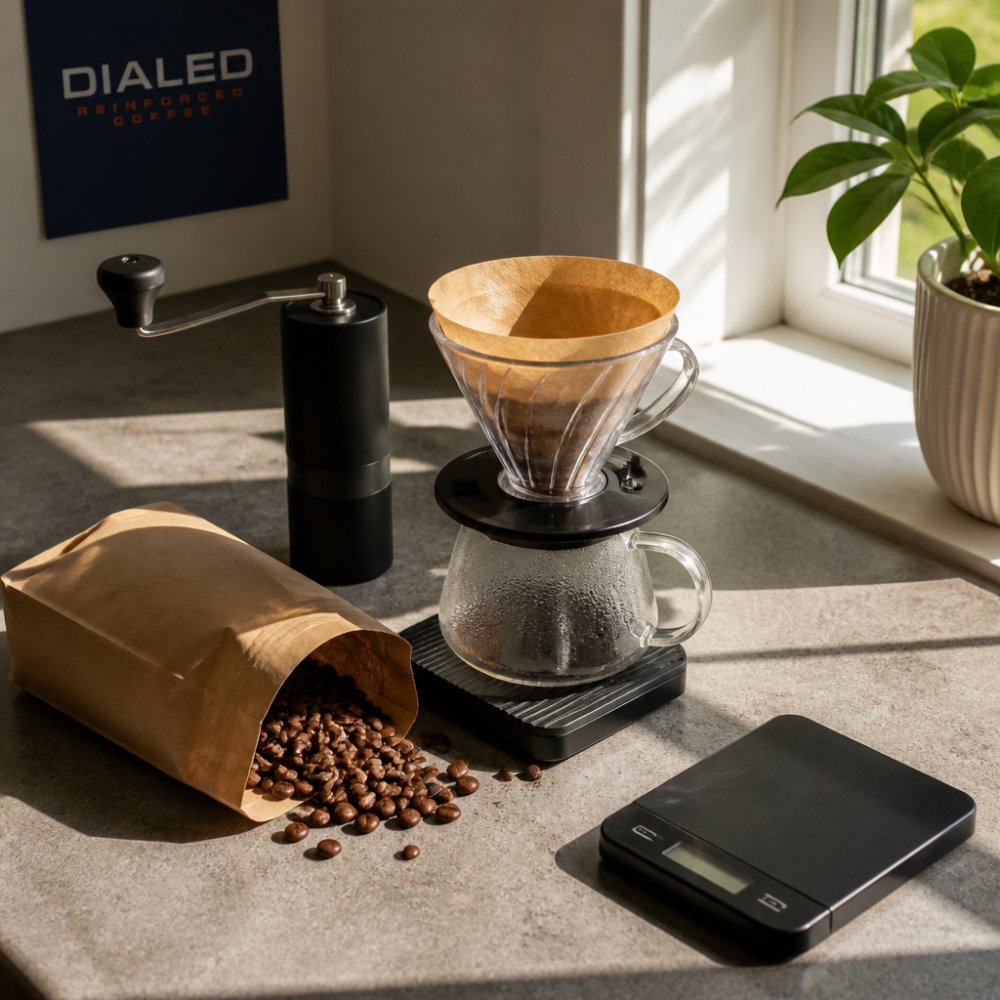
Match Grind Type to Your Equipment
Grind type is the physical size of the coffee particles, and it must match how long water touches the grounds. A fine grind in a French press clogs the mesh and turns the cup muddy. A coarse grind in an espresso machine pulls weak, watery shots.
Here is the practical pairing:
| Brewing Method | Grind Type | Why It Fits |
|---|---|---|
| Espresso | Fine | Fast water flow needs tiny particles |
| Pour-over | Medium-fine | Steady drip extracts evenly |
| Drip machine | Medium | Balanced contact time |
| French press | Coarse | Long steep, filtered by mesh |
Choose the grind that matches your main brewer, not the one you use occasionally.
Whole Bean vs. Ground: What Freshness Actually Requires
Whole bean coffee stays fresh longer because the flavors stay sealed inside the bean. Ground coffee releases those flavors within days. If you own a grinder, order whole bean and grind right before brewing. If you do not, order ground and match the grind to your brewer.
The trade-off is honest: ground coffee is convenient, whole bean is fresher. Neither is wrong. Just know which one your routine supports.
How to Read Roast Level and Flavor Profile Before You Commit
Roast level tells you how dark the beans were roasted, and it shapes the flavor more than most drinkers expect. The roast level moves from light to dark, and each step trades brightness for body.
Here is what each one tastes like in plain terms:
- Light roast: bright, fruity, higher acidity, keeps more origin character
- Medium roast: balanced, sweeter, a good starting point for most drinkers
- Dark roast: bold, smoky, low acidity, roastery flavors lead
Flavor profile is the overall taste impression: sweet, nutty, fruity, chocolatey, or floral. A roaster's tasting notes describe what they detected, not what you will taste. Treat them as a guide, not a promise.
Light, Medium, and Dark Roast in Plain Terms
If you drink coffee with milk or sugar, medium and dark roasts hold up better. If you drink it black and enjoy a tea-like cup, try light.
Single-Origin vs. Blend: Which Tells You More
Single-origin coffee comes from one region or farm, so it shows that place's character clearly. Coffee blends combine beans from several origins to hit a consistent, balanced taste.
Single-origin tells you more about a specific place. A blend tells you more about consistency. For a subscription, blends reduce surprises; single-origin delivers coffee exploration. Neither is superior. Pick based on whether you want a familiar cup or a new one each month.
Best Coffee Subscriptions Fit Different Drinkers, Not One Winner
There is no single best coffee subscription, because drinkers want different things. A high-volume drip drinker and a weekend espresso tinkerer need different plans.
- The routine drinker: wants the same reliable cup, medium roast, monthly delivery
- The explorer: wants variety, single-origin, rotating roasts, smaller bags
- The performance drinker: wants coffee that supports focus and steady energy
Best coffee subscriptions are the ones that match your type. If you want a functional option built around focus, see how coffee with adaptogens for focus fits a specific kind of drinker.
For the performance group, DIALED combines real coffee with 11 nootropic and adaptogenic ingredients, each individually dosed and listed on the label. No proprietary blends.
Best for: drinkers who want focus support without the jitters. Skip if: you only want a plain bag of beans and nothing else.
What Coffee Subscription Cost Really Includes
The coffee subscription cost is rarely just the bag price. Shipping, bag size, delivery frequency, and billing terms all change the real number. A cheap bag with paid shipping can cost more per morning than a slightly higher bag with free delivery.
Compare plans on cost per cup, not cost per bag. The formula is simple:
Cost per cup = (bag price + shipping per shipment) ÷ cups per bag
Cups per bag depends on your dose and bag size. A common starting point is 10 grams of ground coffee per 6-ounce cup, or about 18 grams for a double espresso.
Worked example with round numbers: a $20 bag plus $5 shipping that brews 30 cups costs about $0.83 per cup. A $24 bag with free shipping that brews 40 cups costs $0.60 per cup. The higher sticker price is the better value. Run this comparison on every plan you are considering before you judge a bag by its price tag.
Four cost levers move that number:
- Bag size: larger bags lower cost per ounce, but only if you finish them before the coffee stales. A 2-pound bag is a poor deal for a one-cup-a-day drinker.
- Shipping: many roasters set a free-shipping threshold, often in the $30-$50 range per order. Batching two bags per shipment can clear it and cut per-cup cost.
- Billing cadence: prepaid multi-month plans usually carry the lowest per-bag price, while month-to-month billing costs more but keeps you flexible. Pay for flexibility only when you need it.
- Frequency: shipping every two weeks instead of weekly usually reduces per-order fees, provided the coffee stays fresh for the longer stretch.
Before you commit, check DIALED's website for current shipping terms so delivery fees and timing do not surprise you. Then compare at least three plans on cost per cup using your own dose and drinking volume.
Setting Coffee Subscription Delivery Frequency From Real Consumption
Coffee subscription delivery frequency should follow how much you actually drink, not how much you hope to drink. The reliable method is a short calculation, not a guess.
Step 1: Measure your daily dose. Weigh the coffee you use for one typical day, or estimate from a common dose: about 10 grams per 6-ounce drip cup, 18 grams per double espresso, and 15-20 grams per 12-ounce pour-over. A two-cup-a-day drip drinker uses roughly 20 grams daily.
Step 2: Convert to a weekly need. Multiply daily grams by seven. The same drinker needs about 140 grams per week, or roughly 20 ounces.
Step 3: Match bag size to that need. A 12-ounce bag (about 340 grams) lasts this drinker about 17 days.
Here is how that plays out by habit:
- One cup a day (about 10 grams): roughly 70 grams weekly; a 12-ounce bag lasts about five weeks, so monthly delivery with a smaller bag works.
- Two to three cups a day (20-30 grams): roughly 140-210 grams weekly; a 12-ounce bag lasts 11-17 days, so biweekly delivery fits.
- Espresso household (two double shots daily, about 36 grams): roughly 250 grams weekly; a 2-pound bag lasts about 3.5 weeks, so monthly delivery of a larger bag is reasonable.
- Occasional drinker (a few cups a week): a small bag every four to six weeks prevents stale coffee.
Two adjustments matter. First, account for guests and weekend brewing, which can push consumption up 20-30 percent; size up slightly if that is your pattern. Second, check the roaster's roast-to-ship timing.
If you are unsure, start with a slower schedule and a smaller bag.
Read the Coffee Subscription Cancellation Policy Before You Pay
The coffee subscription cancellation policy decides how much freedom you have after you pay. Some plans let you skip, pause, or cancel with a click. Others lock you into a prepaid term with no early exit.
Check these terms before checkout:
- Can you skip a shipment without penalty?
- Can you pause instead of canceling?
- Does an auto-renewal charge hit before you can react?
- Is there a minimum number of shipments?
Read the subscription terms on the DIALED website before you order. A flexible plan costs a little more per bag but saves you from paying for coffee you no longer want.
Watch out: prepaid plans often offer the lowest per-bag price but carry the strictest cancellation rules. Do not trade flexibility for a discount unless you are certain about your routine.
Build Your First Order With DIALED
The right subscription removes decisions, not adds them. Match your brewer, pick a roast you will actually finish, set a schedule your habit supports, and read the fine print. Do those four things and the rest is easy.
If you want coffee built for focus, DIALED is a smart first order. Every ingredient and dose is printed on the label, and the formula pairs real coffee with nootropics and adaptogens for steady energy. Curious what the product actually is? Visit the DIALED website to learn more before you order.
Frequently Asked Questions
What should I look for in a coffee subscription?
Four things decide whether a subscription works for you: roast level that matches your taste, grind type that matches your brewer, a delivery frequency that keeps beans fresh without piling up bags, and a cancellation policy you can live with. Check the roast date too. Fresh-roasted coffee tastes noticeably better than bags sitting for months, so a roaster that prints the roast date on the bag is a safer bet than one that only prints a best-by date.
How often should a coffee subscription deliver coffee?
Work backward from how much you actually drink. If you brew two 12-ounce cups a day, that is roughly 1.5 ounces of ground coffee daily, or about 45 ounces a month, which is close to a one-pound bag every two to three weeks. Most roasters offer weekly, biweekly, and monthly options. Pick the interval that keeps you finishing a bag within two to four weeks of the roast date, and adjust after the first two shipments once you see your real pace.
Are coffee subscriptions worth the cost?
Compare cost per cup, not cost per bag. A one-pound bag brews roughly 30 to 45 cups depending on strength, so a $20 bag lands around $0.45 to $0.65 per cup, often below a cafe drip coffee. Subscriptions earn their price when they deliver fresh-roasted coffee, free or low shipping, and the flexibility to skip, pause, or cancel. If shipping pushes the per-cup cost well above what you would pay locally, or the cancellation terms lock you in, the math stops working.
Can you customize or pause a coffee subscription?
Most established roasters let you change grind, roast preference, bag size, and delivery interval from your account, and many allow you to skip a single shipment or pause for a set period. Ask three questions before signing up: can I skip a shipment without penalty, how long can I pause, and does the plan auto-renew at the same price? Prepaid plans often trade a discount for less flexibility, so read the renewal terms carefully if you choose one.
Most subscriptions fail because the plan outpaces the habit. Fix that by sizing delivery to your real consumption, then choose a roaster that earns the repeat. DIALED gives you full-dose transparency, third-party testing, and a formula built for sustained focus, not a quick spike. Get started with DIALED and build a coffee routine that keeps you sharp past the afternoon.
