

How to Verify Third Party Supplement Testing
Table of Contents
- Why Third Party Testing Matters for Your Supplements
- What You'll Need: A Verification Checklist
- Step 1: Identify Certification Seals on the Product Label
- Step 2: Perform a Supplement Certification Lookup
- Step 3: How to Read a Supplement Certificate of Analysis
- Third-Party Supplement Testing vs Certification: Key Differences
- Supplement Testing for Contaminants and Label Accuracy
- Common Mistakes to Avoid When Verifying Testing
- Frequently Asked Questions
Last Updated: October 13, 2026
Why Third Party Testing Matters for Your Supplements
Third-party supplement testing is the practice of having an outside lab check a supplement for what it claims to contain, and confirm it holds no harmful levels of contaminants.
The supplement aisle runs on trust. A bottle can say "purity tested" in bold letters and mean almost nothing. No one checks the claim before it hits the shelf.
So the real question isn't whether a brand says it tests. It's whether you can confirm it.
That's what this guide covers. Below, we'll walk through a five-step verification process, from reading the label to pulling the actual lab paperwork. Most people skip straight to the seal and stop there. That's the first mistake, and it's a big one.
What You'll Need: A Verification Checklist
Gather a few things before you start. The whole process takes about 15 minutes per product.
Here's what to have on hand:
- The supplement bottle, with the full label visible
- A phone or computer with internet access
- The brand's website and contact email
- A notepad or notes app for tracking results
You don't need lab equipment or a science background. You need patience and a skeptical eye.
Step 1: Identify Certification Seals on the Product Label
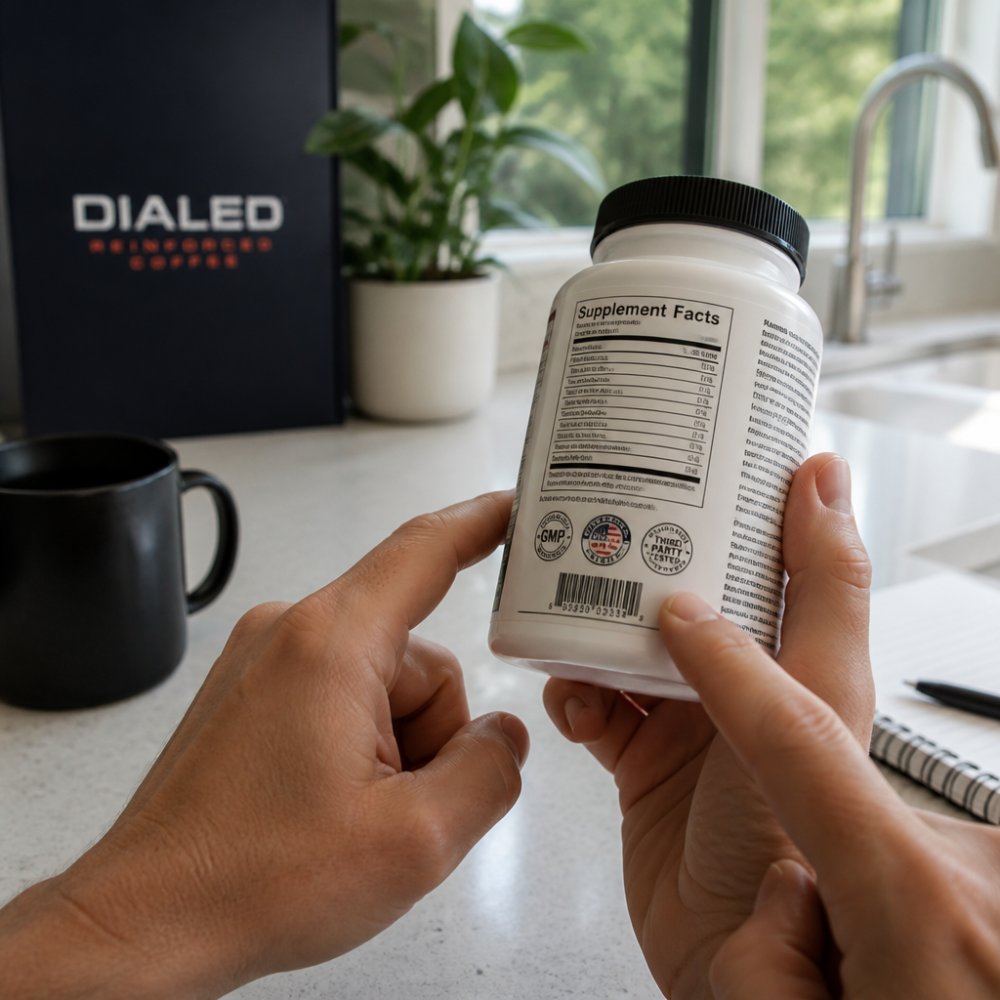
Certification seals are the small logos printed near the supplement facts panel. They signal that an outside group has reviewed the product. Common seals include USP Verified, NSF Certified, and ConsumerLab. Each one means something different, and none of them are interchangeable.
Look for these details on the seal itself:
- The full name of the certifying group
- A license or certificate number, if printed
- The scope of what was tested
A seal without a number is a red flag. Real programs track certified products in a public database, so the seal should lead somewhere.
Step 2: Perform a Supplement Certification Lookup
A supplement certification lookup confirms whether the seal is real. The seal is a graphic; the directory listing is the record. Your job is to match the product in your hand to a current entry in the certifier's own database, not to a photo of a seal on a brand's marketing page.
Start with the certifier's official site, not a search engine. A search result can surface a reseller page, a blog post, or a counterfeit listing that copies the seal image. Go to the source:
- USP Verified, search the USP verified products directory by brand and product name.
- NSF Certified, use the NSF certified products and systems listing, which covers supplements and sports products.
- ConsumerLab, its reviews and product listings sit behind a membership, so treat it as a review source rather than a free public directory.
- Informed Choice / Informed Sport, search the certified product database by brand and product.
USP verified products directory NSF certified products listing
Match the exact product, not the brand
A brand can hold certification for one SKU and not another. A common pattern is a company that certifies its flagship capsule but not its gummy, its powder, or its new flavor. When you search, match on all of these:
- Exact product name, including flavor, size, and serving count
- Formulation, since a reformulated version may drop out of certification
- Manufacturer or contract facility, if the listing shows it
- Certification status and date, so you know the listing is current and not expired
If the directory shows the product but the entry is expired, the seal on your bottle may be from an old run. That is not proof of current testing.
Detect a counterfeit or misused mark
Seals get copied into label designs in seconds. Before you trust one, check the mark itself against the certifier's official artwork:
- Design details, logo shape, font, and color should match the certifier's current mark, not an older or altered version.
- License or certificate number, a real program tracks certified products, so the number should resolve to a listing.
- Product name on the listing, it should match your bottle, not a similar product from the same brand.
- Link behavior, if the brand's site links to the certifier, the link should go to the certifier's domain, not a lookalike page.
When the product isn't listed
Not every legitimate product is certified, and not every certifier runs a free public directory. If you can't find the product, don't assume fraud, but don't assume testing either. Move to the next step and ask the brand for batch-level evidence. A brand that tests can usually produce a certificate of analysis; a brand that only prints a seal often cannot.
Step 3: How to Read a Supplement Certificate of Analysis
A certificate of analysis (COA) is a lab document that lists what was tested and what the lab found. Learning how to read a supplement certificate of analysis takes practice, but the key parts are easy to spot, and the difference between a real batch record and a marketing claim is usually obvious once you know what to look for.
Know which document you're holding
These are not the same thing, and brands sometimes blur them:
- A public certificate, a general statement that a product line or facility meets a standard. It is not tied to your bottle.
- A certificate of analysis, a lab report with test methods, results, and a lot number. This is the document that matters.
- A batch-specific report, a COA whose lot number matches the bottle you bought. This is the strongest evidence.
- An unsupported testing claim, a label or web page that says 'third-party tested' with no document, no lot number, and no lab named.
If a brand shows you a certificate but not a COA, you have a claim, not a result.
Check the lot number first
The lot number is the hinge. A COA without a lot number, or with a lot number that doesn't match your bottle, tells you nothing about what you're holding. Find the lot or batch code on the bottle, usually near the expiration date or on the bottom, and compare it character for character.
Read the rest of the report
Once the lot matches, check these sections:
- Laboratory name and location, a real COA names the lab. An unnamed lab is a red flag.
- Test date, older than a year means stale results for a product you may have bought recently.
- Identity and potency, do the amounts match the label? Look for the tested value and the specification it was compared against.
- Contaminant screen, heavy metals (lead, arsenic, cadmium, mercury), microbes, and residual solvents.
- Methods, the analytical method (for example, HPLC for potency) tells you how the result was produced.
- Pass/fail against a specification, a number without a limit is just a number.
Ask for the batch that matches your bottle
If the brand sends a COA for a different lot, ask again. A common pattern is a brand that posts one clean COA for a product line and reuses it across batches. That is not batch-level verification.
Interpret what you get
A COA is evidence, not a guarantee. It covers the tests the lab ran on that batch, not every possible contaminant, and not the conditions in the facility where the product was made. Read it as one piece of a larger picture, alongside the certification lookup and the manufacturing standards behind the product.
Third-Party Supplement Testing vs Certification: Key Differences
Third-party supplement testing versus certification comes down to one thing: a test is a single result, while certification is an ongoing program. Testing checks one batch. Certification means an outside group keeps checking, batch after batch, and audits the facility too.
Here's how they compare:
| Factor | Third-Party Testing | Third-Party Certification |
|---|---|---|
| Scope | One batch | Ongoing batches |
| Cost to brand | Lower | Higher |
| Public record | Sometimes | Usually |
| Facility audit | Rare | Common |
| Consumer proof | Lab report | Seal plus directory |
Both matter. But certification gives you a paper trail you can check yourself.
Supplement Testing for Contaminants and Label Accuracy
Supplement testing for contaminants and label accuracy covers two separate risks. The first is what shouldn't be there: heavy metals, microbes, and banned substances. The second is what should be there but isn't, or isn't in the amount claimed.
A good testing program screens for both. It checks ingredient identity, verifies potency, and looks for adulterants. It also confirms the label matches reality.
That last point matters most. You're paying for a specific dose. If the label says one amount and the lab finds less, the product fails, no matter how clean it is otherwise.
Common Mistakes to Avoid When Verifying Testing
Most verification failures come from a handful of habits. Fix these and you'll catch problems early.
- Trusting a seal without checking the directory
- Skipping the lot number match
- Accepting a "proprietary blend" that hides doses
- Assuming a big brand name means outside testing
- Never contacting the maker to ask for lab results
That last one is the easiest fix. A quick email asking for the certificate of analysis tells you a lot. Brands that test will send it. Brands that don't will stall.
We built DIALED around that idea. Every ingredient and its exact dose sits right on our label, with no proprietary blends hiding the numbers. Our coffee blends real, full-strength coffee with 11 nootropics and adaptogens, all third-party tested and made here.
Frequently Asked Questions
How can I verify the authenticity of a supplement?
Start by checking the label for third-party certification seals from recognized programs. Then visit the certifier's official website and use their product directory to confirm the exact product and batch. Look for a certificate of analysis (COA) that shows test results for identity, potency, and contaminants. If the product claims third party testing but lacks a seal or verifiable COA, contact the manufacturer directly and ask for documentation. Always be cautious of vague claims like 'lab tested' without proof.
How to find 3rd party tested supplements?
Look for products that display seals from independent certification programs such as NSF Certified for Sport, USP Verified, or Informed Sport. These seals indicate the product has undergone testing for contaminants, label accuracy, and in some cases, banned substances. You can also search the certifier's online directory to find certified products. Additionally, brands that provide a certificate of analysis for each batch demonstrate a commitment to transparency. If a product lacks a seal or accessible COA, it may not be third-party tested.
Do supplements need to be third-party tested?
In the United States, dietary supplements are regulated by the FDA but do not require pre-market approval for safety and efficacy. Third-party testing is voluntary, but it provides an extra layer of quality assurance. Testing verifies ingredient identity, potency, and purity, and screens for contaminants like heavy metals and microbes. While not mandatory, third-party testing helps ensure the product matches its label and is free from harmful substances. For athletes, choosing third-party tested supplements is crucial to avoid banned substances.
Does third-party testing guarantee that a supplement is safe or effective?
No, third-party testing does not guarantee safety or effectiveness. It primarily confirms that the product contains the ingredients listed on the label in the declared amounts and is free from certain contaminants. However, it does not evaluate whether the ingredients work for their intended purpose or if the product is safe for everyone. Individual responses vary, and some ingredients may interact with medications or have side effects. Always consult a healthcare professional before starting any supplement, especially if you have health conditions.
Verifying supplement testing takes 15 minutes, but most people never do it. They buy on trust and hope the label is honest. You don't have to guess. Get DIALED and start with a product that lists every ingredient, every dose, and the testing behind it.